Saturday, June 10, 2006

Week 11(3rd - 11th June)

The North wind huffs and puffs outside Getaway & Skiv despite being parked on a tiny flattened beach overlooking Whalebone Bay and backed by a limestone cliff.


Skiv and Getaway on the edge of Whalebone Bay

Shallow aquamarine waters stretch out before us with patches of sea grass changing the hue. Welcome Swallows swoop around our doorway, the odd one even flits in and out. We collected a special permit (free) from the Shire enabling us to spend one night here. We left Denham early Saturday morning so that we could make the most of this little haven. Taking refuge from the wind this Sunday morning we review the past week…

So hard parting from family! Wondering when we will next see them is the story of our life. While Saxon & Paul returned South we took the road North through the Kalbarri National Park. We spent the day stopping at the scenic spots overlooking the gorges of the Murchison River. Spectacular views of the river meanders, the haunting call of a butcherbird drifting up from the valley below and evidence of the floods that had scoured the system in March this year each added to the experience in different ways.
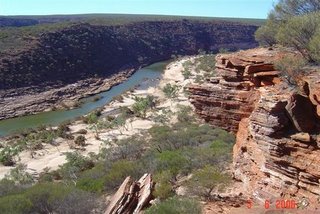
Looking up Murchison river from Nature's Window

We noticed a 10 million year old ripple mark in the sandstone at our feet matched an identical set, 60m below, being formed by the same river in deposits of fresh sand. A humbling thought that provided testimony to the park’s fascinating geological history, the antiquity of the landscape around us and the timeless, inexorable process of erosion. We’d had plenty of walking and beauty to distract us from the sadness of the day. As evening began closing in we left the Park and drove until we reached the old bridge crossing the Murchison inland, just off the new Highway. There, found ourselves a pretty spot in an old road construction camp with an amazingly smart toilet plus fancy ramp! The last of the sunset cast a peaceful light upon our river frontage and we felt content in our 24 hour parking site. Too good to move on, and we stayed far longer…

Sunday beside the Murchison River -
“Where is that helicopter?” Our peace is actually broken by a quad chugging past our caravan with two hefty folk aboard. This 24hr parking site is a particularly fine place for observing the passing population “rolling in” and “pulling out” as we supposedly relax, reading our books.

We discover that the old fellow heavily clothed up for protection against the fierce elements is now the legal caretaker of the fancy toilet block for Main Roads. His old caravan and scattered goods may be parked in a noisy spot below the North West Coastal Highway with road trains steadily plying up and down, but he knows that it is the coolest spot. He even keeps abreast of temperatures in Perth! Told George all about the cyclone generated flood that swept through the site earlier this year. It took the river level over a month to subside.

“Slopes” and “sliders”, the tourist hire vehicles drift in, either to take a peep, stretch legs or enjoy a bite to eat at facilities provided by Main Roads Dept.

A huge rig – slick designer model with shiny silver wrapping protecting the roof rack, drives round checking out the status of possible sites while the wife follows behind in a black Mirage with gleaming mag. wheels.

Hats off to the old fella in his wheelchair – his Mercedes transit van draws up and out pops the electrical ramp and disgorges said wheelchair. His cheerful voice chattering to the dog beside the neighbouring bus, wafts out across the extensive site as he makes his way steadily over to the 3 toilet block, its ramp safely taking him up to the handicapped one. Wonderful to see this expense being put to good use and widening the bush experience for him.

A fifth wheel with a free standing satellite dish; The yacht trailing behind a Land Cruiser being used as a home - underpants and towel drying on the guard rail.

Two ozzie muckers (as JG would say), squashies on their heads discussing whether it was Burl Ives playing on the radio! They catch the last of the evening’s sun on their moon-like bellies alongside their ancient camping bus and a crackling fire in front of them.

The two aussie muckers chewing the fat

Later, George had the opportunity to chat to one of the old Aussie drifters, a former cook on a sheep station and scrutinize his remarkable hat up close! He had stuck a horn, of the last sheep he had slaughtered, onto his hatband (using silicon), and had adorned the brim with wool and some hand-woven “dreadlocks” designed to keep flies away from his face. He mentioned he’d been forced to remove those hanging directly in front of his face because they tended to catch fire whenever he lit a fag!

No wonder our old camp attendant says he’d be lonely in a town. This spot has had comings and goings all day long without being intrusive and although it is half the numbers he’d normally see due to the severe impact the price of fuel has had on travellers – we’d have never guessed it.

Map of Shark Bay Marine Park

Monday, we moved on, upwards to Shark Bay – reputedly one of the most outstanding World Heritage Sites there is to see; important primarily because its high salinity (much of the bay 1.5 - 2 times higher than normal seawater); the resultant salt-adapted marine life and the vast expanse (400 000ha) of sea-grasses – the largest banks in the world. We stopped in on Shell Beach at the bottom of the L’Haridon Bight – this must be the ultimate of shell beaches! Literally billions of tiny white cockle shells up to 5m deep and extending for 120km along the shore lie in a succession of ridges created by storms. They not only form the basis of the shell grit industry but also, once naturally cemented together over time, are quarried and the resultant shell blocks used for construction.

We based up for the week in Denham Caravan Park, overlooking the Denham Sound, a picturesque little seaside town we walked the length of on Tuesday, feeling distanced by our Kiki Stella’s first birthday in the UK.

Monkey Mia, with its famed wild dolphins, is located on the opposite side of the Peron Peninsula. As the dolphins arrive any time between 8.00am and midday we got up far earlier than normal to drive across to the Monkey Mia Nature Reserve to witness the interactions of these marine mammals with people. On arrival, we found a large crowd already assembled on the shore watching a couple of dolphins in the shallows but the numbers of dolphins soon increased to eight, representing three generations of the same family. They have been attracting tourists to Monkey Mia for the past 35 years, imagine the field day a resource economist would have establishing the dollar value of the dolphins. The mind boggles at the amount of money they must have attracted? The feeding and care of the dolphins, carefully managed in an orderly way by CALM Park authorities. The dolphins returned periodically throughout the morning providing the opportunity for latecomers to see them.

Dolphins at Monkey Mia

Long after the crowd had dispersed they still came into the shallows. A group of 5 pelicans on the beach were equally entertaining. Preening, clattering their bills, yawning, tugging at sea grass washed up on the shore, uttering guttural roars and resting with their heads facing backwards on twisted necks all contributed to a favourable impression of our day in Monkey Mia.

While the caravan park took care of “Getaway” for $3 we went “bush” in “Skiv” to explore the 52 000 ha of arid scrub-lands and coastal scenery that make up the Francois Peron National Park.

The scrublands of the Francois Peron National Park

Having once been a sheep station it was interesting to learn that because of the thick scrub sheep could not be mustered in the conventional way. Instead, they were trapped at watering sites and herded along 30-40m wide laneways which led towards the Peron station. One laneway from Monkey Mia ran for 40km. Why anyone ever thought that the terrain and vegetation was suited to sheep farming is beyond belief.

The road (45km) was covered in deep sand in many places, sufficient to make Lea feel quite nervous as “Skiv” roared her way through the drifts in 4WD, bucking like a bronco and swaying from side to side. Cape Peron lay at the far end of the track and proved to be a perfect spot to spend the day fishing and walking. All too special to leave before nightfall to take up our place in an authorised camping spot! Sleeping in “Skiv” was hardly likely to impact unduly. We walked a good part of The Wanamalu (pied cormorant) trail along the crest of the red dunes, with lovely views of the Marine Park. With an estimated 10,000 dugongs living in Shark Bay our primary objective was to find some. Our search of the clear, calm shallows was in vain. Perfect weather lulled us into choosing to do the whole trail to Skipjack Point next day – Sadly, we didn’t ‘seize the day’!

Our walk to Skipjack Point was ruined by the strong wind that arose during the night. We drove there instead and took the boardwalk out to the viewing platforms where the “big five” (turtles, dugongs, dolphin, sharks and manta-rays) are a major draw card. Being totally exposed to the wind it was impossible to stay for long and we peered downwards into water so rough it made for poor visibility. While bumping our way back down the sandy tracks and skirting the edge of the birridas (ancient clay pans) to Denham, we met a Park vehicle busy flattening out a section of road by dragging huge grader tyres behind it. We exchanged pleasantries and learnt the dugongs have moved further a field into warmer waters. Perhaps we’ll catch sight of them further up the coast?
The wind has now dropped and we are off to walk the limestone bluffs before pulling out of Whalebone Bay late this afternoon for Nanga Bay. Hopefully we’ll find an internet connection there.

Saturday, June 03, 2006

Week 10 (27th May - 2nd June)

Leaving Perth, we trundled northwards with Paul, Saxon & Harley the sausage dog (Sacky’s “little Baba” and “the best dog in the world”) following behind. At Lancelin a few hours on the beach gave Harley the opportunity to have a run but towards evening we pulled off the Brand Highway and set up camp in an attractive rest area where, three and a half years previously, we had spent the night with Otto when he was 14 months! Even the kookaburras were still there giving us a fine rendition of their evening chorus, their peels of laughter creating a true Aussie atmosphere amongst the wandoo gums as we got the fire going to cook hamburgers over the coals.

Campsite at Wandoo rest area near Jurien - the site of Harley's bee-sting
How easily a relaxed and happy morning preparing to leave can change in an instant. Suddenly, Harley began retching, frothing at the mouth and staggering in a manner indicative of paralysis. The sheer horror that she may have eaten some poison lying around the campsite (1080 dropped by a crow?) crossed our minds. A very distraught Sacky and Paul rushed off in the direction of Eneabba (50km away) with Harley passed out in the car to see if they could find a vet. We followed on behind hoping to meet up with them and worrying ourselves sick. Phones were useless as we were out of range. We continued on to Geraldton (200km away) feeling sure that was where the next vet would be and we would have mobile reception.

There was still no sign of them in Geraldton so we sat in the forecourt of a service station anxiously waiting for a call. Two hours later – relief! Saxon called from the outskirts of Geraldton to say Harley had gone into anaphylactic shock as a result of a bee sting. They had been sent to a vet in Dongara who had administered a shot of steroids and anti-histamine. Sacky & Paul were convinced she had died but, like Kleinman the honey badger who got bitten by a puff-adder and came back from the “dead”, she was none the worse for her experience. Reunited and emotionally drained yet greatly relieved we continued on to Kalbarri (150km).

Setting up camp in the Red Bluff caravan park George experienced his first real problem trying to back the caravan into the site we had been allocated … even with the able “assistance” of Paul, Saxon and Lea along with three neighbouring caravan owners telling him which way to steer (“left-hand down!”, “right-hand down!”, “full lock!”, “forward” ….) Absolute chaos, made worse by discovering that once perched on its pocket handkerchief sized parking place (a concrete plinth), the corner stabilisers would not reach the ground and the van was far from level and … wait for it …. Lea and Sacky’s discovery of a drive-through site in a much better position (out of the wind and further from the road)! So, after all that Getaway had to be hitched up again and moved!

Paul and George planned a major assault on the fish stocks of the Kalbarri region, a recce of our surrounds followed the next day.

Looking down the barrel of a nose - the meeting of a crab and Harley the nosey parker

We checked out the fishing spots below Red Bluff, along the beach and at the mouth of the Murchison estuary; bought bait and prepared our gear but our first attempt, so typical of shore based marine angling, was a dismal failure. The surf too powerful, the gully we selected too rocky and slippery …. we may as well have just emptied our tackle boxes and bait into the sea!

The warm weather we had been hoping for never materialised. The fishing did not get any better. We tried poppers, lures, super jigs, sardines and prawns as bait …… but never had a touch and eventually resorted to taking a drive along the coast to have a look at the strikingly coloured sandstone cliffs of the Kalbarri National Park.

One of the most interesting spots is Rainbow Valley where, quite apart from colour of the multi-layered sandstones (some 400million years old) George was mystified by the array of sandstone tubes that hung vertically along the edge of the many overhangs.

Ancient remains of the vertical burrows of the sand worm Skolithos

Subsequently he learnt that they were burrows of a sand-worm (Skolithos) that lived in Silurian times on the floor of the ocean! The compacted sand that filled the burrows (this having been ingested by the worms) was more resistant to weathering and left standing after the softer sediments surrounding them were eroded away. The densely packed distribution of the burrows was staggering and suggested that the animal must have once been in incredible abundance on the sea floor.

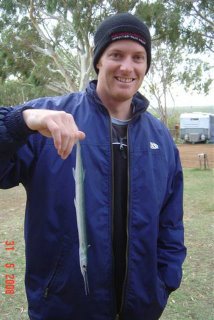
Paul and his craftily snagged barred longtom

At last Paul succeeded in foul hooking a barred longtom by casting his lure on top of the poor things head, and to mark the event, we cooked the long ribbon of a fish for breakfast. Later, three undersized silver bream were caught (and released) by Paul. With the score now standing at four : zero, a family fishing competition (Begg vs Gee) was planned! The event took place at Chinaman’s Point and within minutes the Gee couple were two fish ahead. The Beggs struggled, George finally landing a tiny blowfish (vermin) and a bream so small that to avoid being accused of murdering juveniles it was hastily released. The Gees may be better fishermen but we still had nothing for the frying pan all week!

Just before leaving Perth we had lunch with Diana & Peter Ryan. Days later they met up with their friend Di Godson and told her to look out for a troopie sporting buffalo horns probably roaming around Kalbarri at the same time as she’d be visiting the region. Co-incidentally, Di Godson was at Arundel School with Lea, her brother at Peterhouse with George, so we had the unexpected pleasure of catching up one evening.

With Saxon and Paul returning to Perth tomorrow (Saturday) we will move on exploring the gorges of the Murchison River in the Kalbarri National Park.

Friday, May 26, 2006

Weeks 6 - 9 (1st - 26th May)

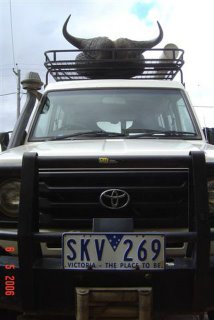
Rolled into Perth for a month of family time staying with Saxon & Paul. Travel takes its toll so the whole team required a “service”… Getaway had her “teething” problems ironed out and was given a 10,000 km check-up. George went to observe Skiv’s oil and filter changes so that he can do it himself along the road. A mini bookcase and cooler box has been fitted behind our front seats; the roof rack removed and repainted; a pair of buffalo horns (from Kariba!) mounted on it giving Skiv a striking new appearance (Excuse me… more like a Territory hoon!)
We have even had a “Rubber Tramps” sticker put on the back of “Getaway”! Lea’s chiropractor fixed her back after a grape grounded her in a Melbourne supermarket and the dentist fixed the tooth she broke on an olive pip in Hermanus. Sun worshipper George had his skin checked and cancers removed.
We consider ourselves lucky to have been blessed with perfect summer weather throughout May with just a hint of winter as evenings draw in and look forward to more of the same as we prepare to trek into the northern parts of Western Australia. We have certainly been kept busy with preparations for this leg; Saxon has lined shelves, drawers and cupboards with thick non-slip matting to cut the damage caused by vibration. A generator purchased and run in to enable us to be self sufficient with regard to power; Lea’s been busy baking and stocking up the pantry. Things have never looked better! The only disappointment has been the realisation that, weighing over 2.8tons, Getaway is too heavy for the remote controlled caravan mover to work optimally but it’s a great blessing when it comes to hitching it up.

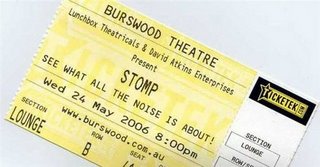
In between we have been able to socialise with many of our Perth friends ….. see a movie (Tsotsi) and rounded off our stay with “Stomp” - a spectacular show performed by 8 characters that entertained us for two hours beating out the most infectious rhythms on everything from brooms to dustbins; buckets and kitchen sinks; empty water containers; rubber pipes; match boxes; lighters; newspapers; footballs and plastic bags … accompanied throughout by wild dancing, clapping and foot stamping.

There being no peace for the wicked, George helped Paul build the decking around their newly acquired, outdoor spa bath. Saxon & Paul, along with sausage dog Harley, have taken a week off work to travel in convoy with us up to Kalbarri. There, we’ll spend six days together in a caravan park at Red Bluff. Hopefully the men will catch the tucker as fishing is said to be good there. We intend exploring the Murchison river and finding time to do some serious relaxing on the beach. Posted by Picasa

Monday, May 01, 2006

Week 5 (24th - 30th April)

Nullarbor Plain - the name implies a treeless expanse of flat, perhaps uninteresting land. It wasn’t! We discovered was that the Nullarbor does have trees. Over hundreds of years plant succession has, and presently is, changing the face of the plain. A surprising diversity of vegetation and landforms occurs.

Leaving Ceduna was through a man-made Nullarbor – a treeless landscape cleared by man for the sake of growing wheat and rearing sheep. A few pockets of mallee left as a pitiful reminder of what used to be there. The attractive eucalypt woodlands in the Yalata Indigenous Protected Area (Aboriginal land 150km from Ceduna) brought welcome relief and we kept a sharp eye out for the Dingo Fence. A pet dislike for George as he cannot understand how anyone in this day and age can justify the existence of a 2.8m high mesh fence running 6000km from South Australia to Queensland. As we entered the Nullarbor National Park we saw a dingo (a fine looking specimen) trotting across the road and wished it well.


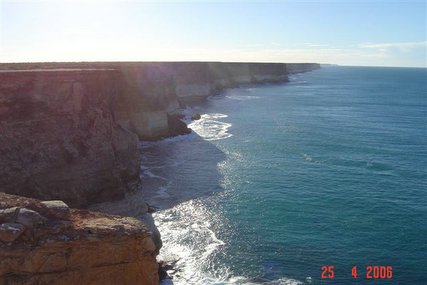
The Bunda Cliffs, unbroken rampart along 200kms of the Bight

The Great Australian Bight actually looks as if a big bite has been taken out of the continent. Along 200km of the coast, two-toned limestone cliffs plummet 40-90m vertically into the Southern Ocean. Impatiently, we expected to find signs indicating where the best view sites were. All we could see were small tracks leading off the highway. Taking one of them we ended up on the edge of the cliff-face, looking down on swells gently rolling in, almost lapping, against the base of the cliffs below. Nothing like the fearsome action we’d seen at Coffin Bay on the Eyre Peninsula. Except for the flies and the noise of the wind sounding as if it wished to push us over the cliff … it seemed to be a fine place to spend our last night in South Australia.


Campsite above the Bunda Cliffs on the Nullarbor

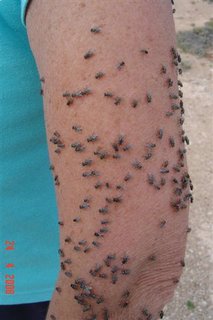
The FLIES! Swarms of the bastards taking cover from the wind by clinging to our bodies and clothes, resulted in the photo below being taken in an attempt to outdo the shots of Colleen covered with bees in the Kalahari!

Flies sheltering from the wind on Lea's arm.

The flies, always at their worst in arid areas torment everyone. One has to smile at the antics of everyone doing a snake dance to rid themselves of these hitch hikers before leaping into their vehicles. Inevitably they get in with you. We’d try to beat them to death but the flies generally had the upper hand. Eventually we would drive with both doors open and blow the blighters out of the cab! How a determined young cyclist we saw pedalling across the plain coped with the flies doesn’t bear thinking! At the SA / WA border quarantine station the sight of a poodle desperately snapping away at flies in a campervan undergoing inspection, made us laugh.

Travel timing can so easily affect what we would like to see and do. The Head of the Bight, the premier whale watching spot on the coast was closed. It was too early for the whales. Access to the Eyre Bird Observatory required a phone call appointment. Our phones were out of signal range the entire Nullarbor trip. Even the Cocklebiddy caves, where the remains of Tasmanian tigers had been discovered, were closed due to heavy rains having destabilised the entrance.

On Australia’s longest straight road (146km) a convoy of mini-mokes passed us on their way … wait for it … to a “moke muster”! Approaching road trains would blow the wing mirror flat every time they thundered past us and at times the road was marked out as a landing strip for the Royal Doctor Flying Service. At one point we found two youngsters pushing their clapped out old car along a track and, after trying to start it using jump leads, landed up unhitching the caravan, leaving Lea at a truck stop and towing them back to civilisation.

We enjoyed quiet, secluded roadside camps along the way with a variety of weather – Temperature rose steadily to 37°C on one day set between mostly cold days at a low of 7°C. An approaching front brought heavy rain which caught us on a stretch of road undergoing reconstruction. Skiv and Getaway had their first good mud bath. Dead kangaroos in different stages of decomposition are generally all we see along the road. What a pleasure it was to come across live kangaroos after the rain. Only trouble being they heighten the risk of being killed by drinking from the puddles that had collected on the road’s impervious surface.


Bush camp on the Fraser's range

Nearing Norseman, a historical gold mining town at the western end of the Nullarbor, we traversed one of the most beautiful areas of all – the Dundas Nature Reserve. Said to be “the greatest untouched temperate woodland in the world” and extending over 250 000km², the sight of masses of bronze barked gimlets gleaming in the morning light; reddish-pink salmon gums and ribbon-bark gums (with their long ribbons of bark swaying in the breeze) was a sight to be seen.

And who would have believed that when pawing the ground whilst tethered to a tree, a horse first discovered gold at Norseman? It got a chunk of gold bearing quartz stuck in its hoof and went lame! A fascinating little place with accounts of prisoners being chained to logs because there was no jail and of houses being made from almost anything, including flattened bully beef tins!

Week 5 continued...

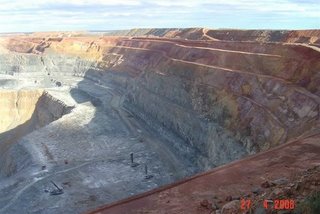
Late afternoon we pulled into the Gold Capital of Australia - Kalgoorlie and after washing our mud splattered vehicle we went up to the viewpoint that looks out over the Super Pitand could scarcely believe our eyes. An open cut mine that has already yielded 50 million ozs of gold and in time will be 3.8km long, 1.5km wide and 500m deep! Deep inside the pit were huge ($3.5 million) haul trucks each carrying 225 tonnes of waste rock crawling their way, like ants, along roads that zig-zagged gradually upwards to the rim of the mine; enormous 650 ton mechanical shovels capable of lifting 55 ton with each scoop all frantically digging away. Apparently it takes seven 225 ton truck loads to produce 2oz of gold and that is considered worthwhile!


Kalgoorlie Consolidated Gold Mines' Super Pit

We took the road to Perth following the “golden” lifeblood… a pipeline carrying all the water to the Goldfields from Perth. This route had some remarkable places of interest to stop and see like the home of an old prospector (Jack Carins) who lived for 30 years in a little tin shack built of anything that he could lay his hands on.In the Goldfields Woodland National Park we camped at Boondi Rock, a granite outcrop that was ingeniously developed as a catchment for the railway water supply. The carefully constructed perimeter walls and rock lined channels that directed rainwater (run-off) into a small dam were outstanding. The ornate dragon lizards running around the rock at breakneck speed were an added bonus.

Boondi Rock catchment

We just had to stop at the notorious Rabbit Proof Fence. The 3 500km long fence had been built over the period 1901 – 1907 because of the impact of the steadily increasing rabbit population. In order to construct it 8000 tons of wire and netting were transported to Australia by ship and rail, then moved overland by horses, donkey and camel trains. After being dipped in hot coal tar the bottom of the fence was buried underground; gates were provided every 34km; yard traps were positioned every 8km to capture the rabbits; and huts were built every 48km to accommodate the inspectors and boundary riders used. Although the rabbit population declined in the late 1950’s after the introduction of myxomatosis, the threat of emus drawn to agricultural areas in search of feed during droughts presented the next problem! In the drought of 1976 for example, 100 000 hungry emus gathered along the fence. Now called the State Barrier Fence, its purpose is to reduce the threat of migrating emus as well as exclude feral dogs and goats. Any excuse will do?

The little town of Meckering was our last stop off where, on 14th Oct 1968 the entire place was destroyed by an earthquake measuring 6.9 on the Richter Scale. The quake only lasted 40 seconds but in that time all the buildings, the highway, the railway, the water supply pipeline, as well as the power and phone supplies were disrupted. However, in true Aussie fashion within 24 hours the owner of the pub moved all his liquor over the road to the Shell garage, renamed it “The Quake Arms”, and was soon selling beer reputed to be “All Shook Up”. Elvis Presley would have been proud of him?

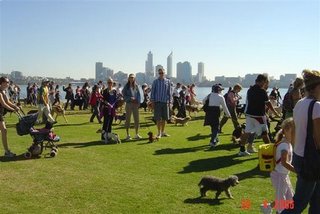
We are now back with Sacky and Paul in Perth and experienced the spectacle of the “Million Paws Walk”. A marvellous way of ending our week seeing the array of weird and wonderful dogs brought along by thousands of RSPCA supporters is something we are glad not to have missed. The Swan estuary and the skyscrapers of the city in the background, the setting was magnificent.


Harley, Pixel and their owners on the Million Paws walk

The month of May will be spent with our daughter and husband. We will be servicing the rig, organising the inside of Getaway in readiness for the journey north. Posted by Picasa